

New AI models, research papers, and benchmarks appear at a remarkable pace. This makes it difficult to decide what is truly worth studying. In this Sutskever’s List review, I explore how the book organizes the key ideas, research breakthroughs, and engineering advances that shaped modern artificial intelligence.
Disclosure: This review contains affiliate links. If you purchase through these links, we may earn a small commission at no additional cost to you. Your support helps us continue creating free learning resources on Noro Insight.
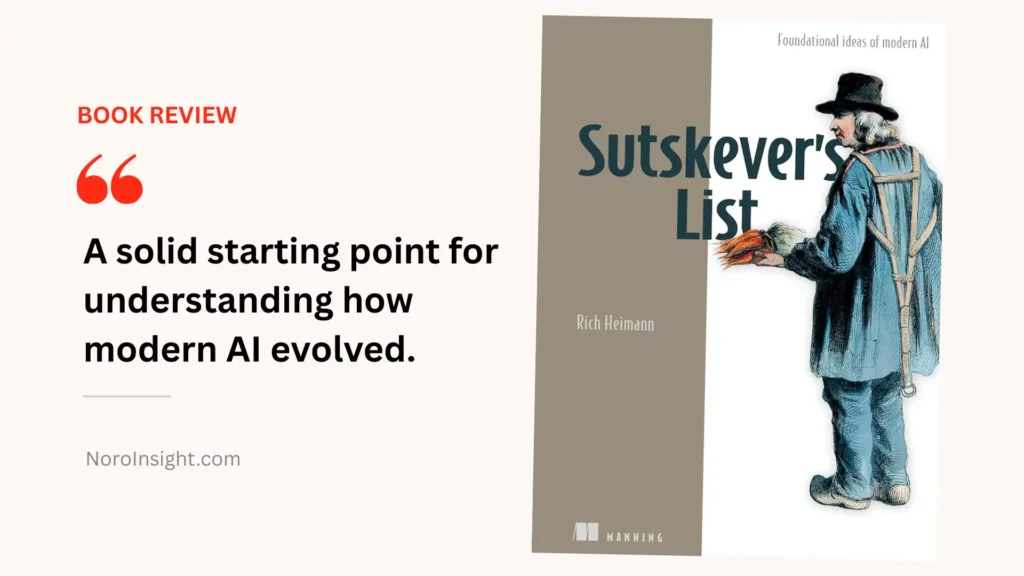
Sutskever’s List: Foundational Ideas of Modern AI explores these important ideas. The book is written by Richard Heimann, Director of Artificial Intelligence for the State of South Carolina, and published by Manning.
The book was inspired by a well-known story about Ilya Sutskever, OpenAI co-founder and former chief scientist. According to the story, Sutskever shared an AI reading list with programmer John Carmack. The list reportedly covered “90% of what matters” in artificial intelligence. The original list was never made public. However, reconstructed versions have circulated throughout the AI community. Heimann uses one of these versions to explore the papers, breakthroughs, and historical events that helped shape modern deep learning.
The book goes beyond summarizing famous research papers. It explains the patterns and connections between them. In this review, I examine seven aspects that make Sutskever’s List a useful roadmap for understanding the ideas, research, and engineering behind modern AI.
What This Sutskever’s List Review Covers
1. A Curated Roadmap to Modern AI
Artificial intelligence evolves so quickly that even experienced practitioners can struggle to keep up.
New architectures, benchmarks, models, and research papers appear on a near-daily basis. As a result, it can be difficult to separate foundational ideas from temporary trends.
One of the book’s greatest strengths is that it does not attempt to explain everything.
Instead, it uses a reconstructed version of Sutskever’s famous reading list as a guide through some of the discoveries that shaped modern deep learning.
For readers looking for direction rather than information overload, this curated approach is refreshing.
2. More Than a Technical Book
This is not simply a collection of paper summaries or mathematical explanations.
Alongside discussions of architectures and research breakthroughs, the book explores the stories surrounding them.
It describes the excitement created by new discoveries, skepticism from researchers, changing attitudes within the AI community, and important moments such as the GPT-2 controversy.
This broader context helps readers understand not only what happened, but also why certain developments mattered.
It gives the book a more human and engaging feel than many traditional AI textbooks.
3. An Accessible Guide to Influential AI Research
Academic papers can be difficult to read.
They often contain complex notation, dense technical language, mathematical assumptions, and references to earlier research that newcomers may not recognize.
Heimann finds a useful middle ground.
He explains important ideas without assuming that every reader has a research background. At the same time, the book includes enough technical detail to remain valuable for more experienced readers.
For beginners, it can make influential AI papers feel less intimidating.
For practitioners, it can provide historical context and help connect ideas that may otherwise appear unrelated.
Start here first
4. A Window into Ilya Sutskever’s Thinking
The book does not attempt to identify the objectively “best” papers in artificial intelligence.
Instead, it explores ideas associated with Ilya Sutskever’s views on learning, intelligence, scaling, neural networks, and progress in AI.
The reconstructed list may not perfectly match the original version. However, the book raises a more interesting question:
What made these ideas worth recommending?
This question encourages readers to look beyond individual papers and think about the principles connecting them.
5. The Hidden Connections Between AI Breakthroughs
The chapters do not feel like isolated paper summaries.
Instead, the book shows how one discovery builds on another.
Readers move through developments in computer vision, AlexNet, recurrent neural networks, attention mechanisms, Transformers, scaling laws, and reasoning models.
This progression makes modern AI feel like a continuous story rather than a collection of unrelated inventions.
It also helps readers understand that breakthroughs rarely appear from nowhere. They usually emerge from decades of accumulated research, experimentation, and engineering.
6. The Power of Engineering and Scale
Many important AI breakthroughs did not come from theory alone.
They also depended on better engineering, larger datasets, improved training techniques, specialized hardware, and increased computing power.
The book discusses topics such as efficient training, parallelism, scaling laws, distributed systems, and hyperscale infrastructure.
These examples demonstrate that a strong theoretical idea becomes truly influential only when researchers can train, test, and scale it successfully.
This is an important lesson for anyone studying modern AI. Progress often comes from the combination of research insight and engineering execution.
7. A Framework for Understanding Future AI Developments
Much of the book focuses on the history of modern AI, but it also connects those earlier developments to current and future questions.
The later chapters discuss reasoning models, intelligence, superintelligence, and AI safety.
The book does not offer simple predictions about where AI is heading.
Instead, it gives readers a stronger framework for evaluating future developments. By understanding how earlier breakthroughs emerged, readers can better assess new models, claims, and research trends.
What the Book Does Not Provide
Readers looking for detailed mathematical derivations, coding exercises, or step-by-step implementations may need additional resources.
The book is primarily a conceptual and historical guide rather than a hands-on programming textbook.
It can help readers understand why influential papers matter, but it does not replace studying the original research or implementing the ideas in code.
Who Is This Book For?
This book may be useful for students who want to understand the foundations of modern AI, as well as developers and engineers who want more context behind major AI architectures. It can also help readers who find academic papers difficult or confusing, along with AI professionals who want to connect research history with current developments. Additionally, it may appeal to anyone interested in Ilya Sutskever’s perspective on learning, scaling, and intelligence.
No coding is required because the book focuses on ideas, history, and understanding rather than hands-on programming.
The book may be especially helpful for readers who already know basic AI concepts but are unsure which papers and ideas they should study next.
Buy the Book
If you want to understand the foundational ideas that shaped modern AI, Sutskever’s List: Foundational Ideas of Modern AI by Richard Heimann is available here:
Affiliate links.
Final Thoughts
Sutskever’s List offers a clear path through some of the ideas that shaped modern AI. Its main value comes from showing how important papers, technical breakthroughs, and engineering decisions connect.
The book does not replace the original research papers. Instead, it can make those papers easier to approach and understand.
For readers who want a guided introduction to the foundations of modern deep learning, this book provides a useful starting point.